The Business Case for Constraint-Based Configuration
Why complex-product CPQ must encode the product, not the sales script — and what that means for accuracy, agility, and AI readiness.
Founder & CEO
Predictika.ai
Email: sanjay@predictika.com
Executive summary
For companies that sell complex, configurable products, the configurator is not back-office plumbing. It is where revenue, margin, and customer trust are won or lost on every deal. When it produces a configuration that is subtly wrong, the cost is concrete: rework and change orders, delayed delivery, eroded margin, and a customer who no longer trusts the quote. When it is slow or rigid, deals stall and buyers walk.
Most “configure-price-quote” (CPQ) technology was built for a simpler world: products that are essentially a short list of compatible options. For those, it works well. But an important and growing class of products — industrial machinery, telecommunications systems, medical devices, high-tech and data-center infrastructure, configurable financial and service offerings — is deeply structured, bound by hard limits, and unforgiving of error. For these, the conventional approach (a guided decision tree backed by an ever-growing body of special-case rules) fails in two predictable ways. It becomes unmaintainable as the product grows, because the logic multiplies with the combinations rather than the features. And it forces a rigid, fixed-order interaction that neither expert buyers nor modern AI assistants can work within.
This paper makes the business case for a different foundation: constraint-based configuration. Instead of encoding the sequence of sales questions, a constraint engine encodes the product itself — its parts and the rules that must always hold among them — and guarantees a valid configuration no matter what is chosen, in what order, or from which direction. The same properties that make such a model maintainable also make the buying experience flexible, and make the engine the natural, deterministic foundation beneath AI-driven configuration. The result for the business is fewer errors, faster change, lower total cost of ownership, and a configuration platform that is ready for how customers will buy next.
Configuration is where complex deals are won or lost
Configuration during the sales process spans a spectrum defined by product complexity. At one end, guided selling handles products that are fundamentally a short list of compatible options — a laptop with a processor, a memory tier, and a warranty. The choices barely interact, a handful of compatibility and pricing rules suffice, and a short ordered flow is enough.
At the other end, complex products have four properties that change the economics of every quote:
- Deep structure — a product built of subsystems built of components, several levels deep.
- Cross-cutting dependencies — a choice in one subsystem constrains a choice in another, often far away.
- Aggregate limits — total power, weight, cost, capacity, or footprint that must stay inside hard budgets.
- A high cost of error — an invalid configuration is not merely suboptimal; it is unbuildable, unsafe, non-compliant, or unprofitable.
When configuration goes wrong on products like these, the business absorbs the cost in familiar ways: invalid quotes that trigger change orders and rework; delivery delays and expedite costs; margin leakage from mispricing; deals lost to slow or error-prone quoting; constant escalation to a handful of scarce experts; and friction that makes partner and self-service channels impractical. As products grow more complex and sales cycles compress, these costs compound — and they trace back to how the configurator represents the product.
Why conventional CPQ breaks down on complex products
The dominant approach encodes a configuration as a decision tree — a guided sequence of questions — augmented by procedural rules of the form “if this option is chosen and that one is not, enable this, adjust the price, hide that.” For shallow logic this is transparent and quick to build. It breaks on depth in two distinct ways, each with a direct business cost.
Maintainability: the hidden tax that compounds
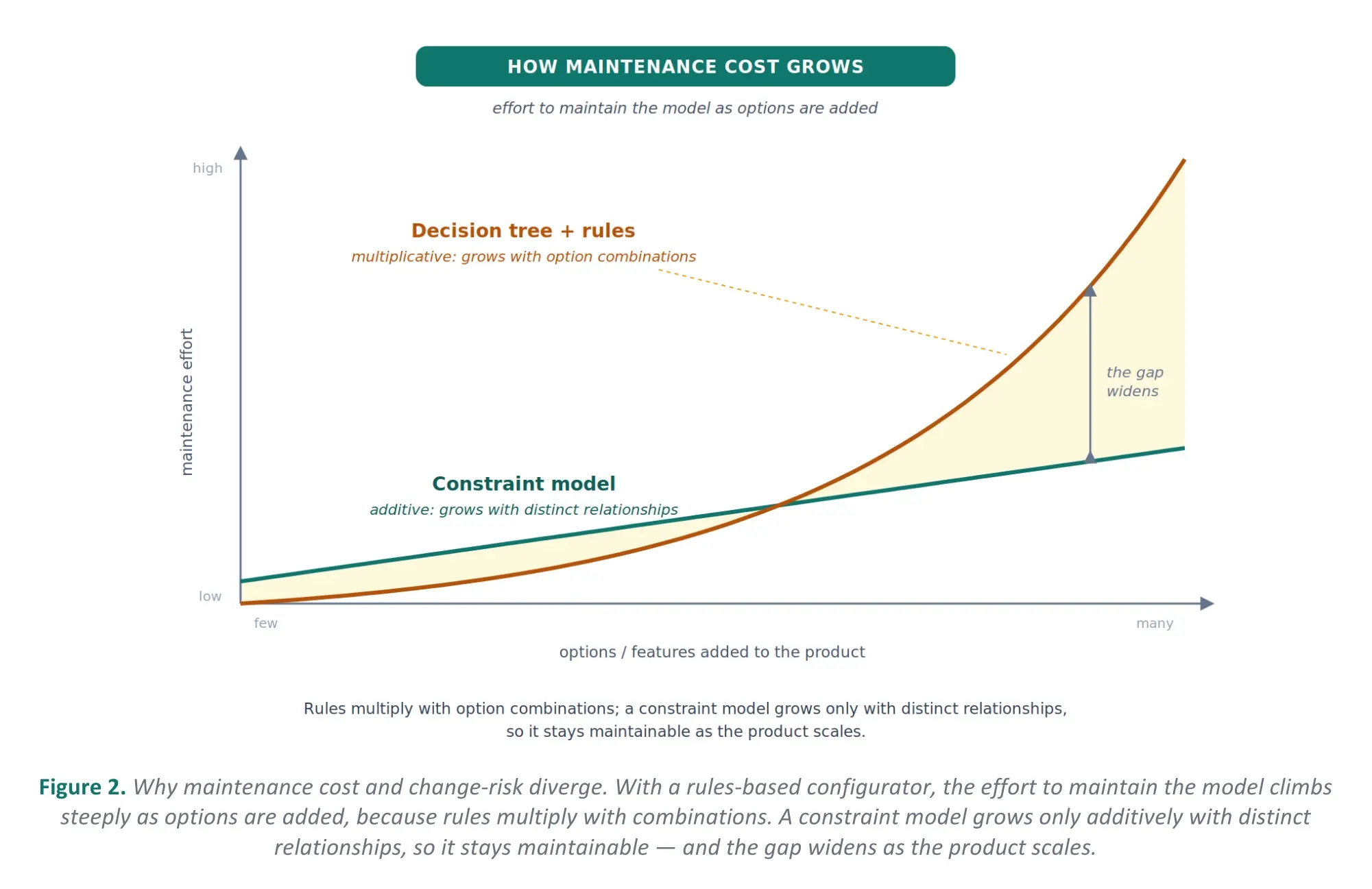
In a rule base, complexity grows with the number of option combinations, not the number of options. Each new choice can interact with many existing ones, so rules and branches multiply roughly combinatorially. Logic gets duplicated across paths; a special case fixed in one place silently reappears in another. Real configurators routinely accumulate hundreds of hand-maintained rules to cover interactions a declarative model captures in a handful of relations. The deeper cost is not just the authoring effort. It is that no one can predict every path a change will touch — so every change is risky, every product update is slow, and the configurator ossifies. The business feels this as delayed launches, an IT backlog, dependence on the few people who “understand the config,” and a maintenance bill that rises every year.
Rigidity: a buying experience that fights the buyer
A decision tree fixes the order of questions, but serious buyers do not arrive in a fixed order. A buyer says, “I need this capacity, in this footprint, under this budget, using these components” — an answer to questions that sit far apart in any tree, some of them outputs rather than inputs. A tree cannot accept a goal-first, partial, or out-of-order specification. It cannot run its logic backward, and it cannot answer the question every expert asks: given everything chosen so far, what is still possible? Each of those is a different path through the same product, and a tree encodes exactly one. The consequence is a rigid experience that frustrates expert buyers, blocks self-service and partner channels, and — increasingly decisive — cannot sit safely behind an AI assistant.
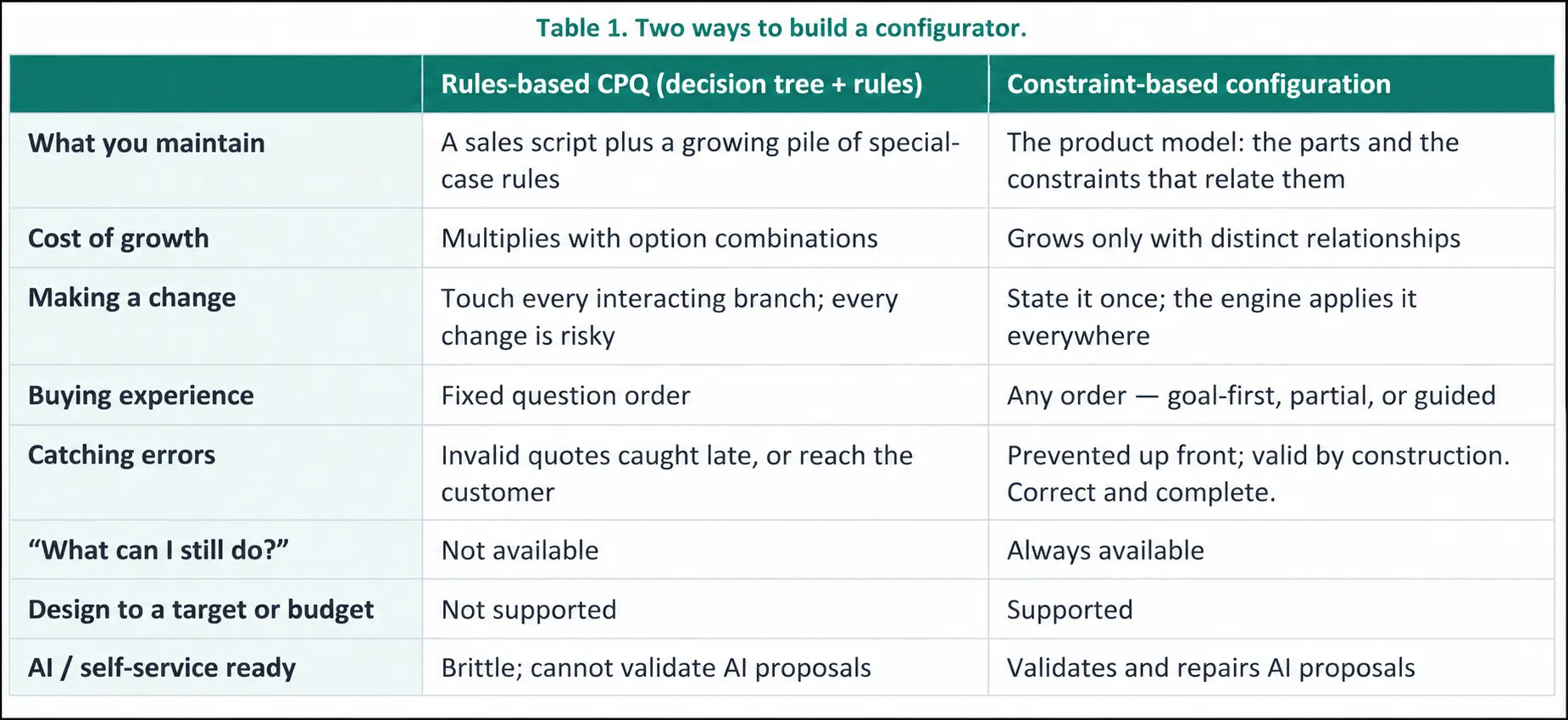
Table 1 summarizes the difference in business terms.
A better foundation: encode the product, not the sales script
A constraint-based engine starts from a different premise: do not encode the decisions; encode the product. A constraint model is a plain description of the parameters that make up a product and the constraints — the relationships that must always hold — among them. Compatibility, capacity, redundancy, pricing, and budgets are each stated once, as relationships, independent of the order in which anyone fills things in.
From that single model, the engine keeps every configuration valid automatically. Choose a value and it works out the consequences across the whole product; it narrows what is still available, recomputes totals, and never allows an invalid state. Because each rule is stated once and enforced everywhere, the model stays a faithful, understandable picture of the product rather than a tangle of special cases. Three business-relevant properties follow directly:
- Correct by construction — invalid configurations are prevented up front, not discovered late or shipped to a customer.
- One source of truth — every fact about the product is stated once, so changes are localized and low-risk.
- Flexible by nature — the same model supports any order, any direction, partial input, and designing to a target or budget.
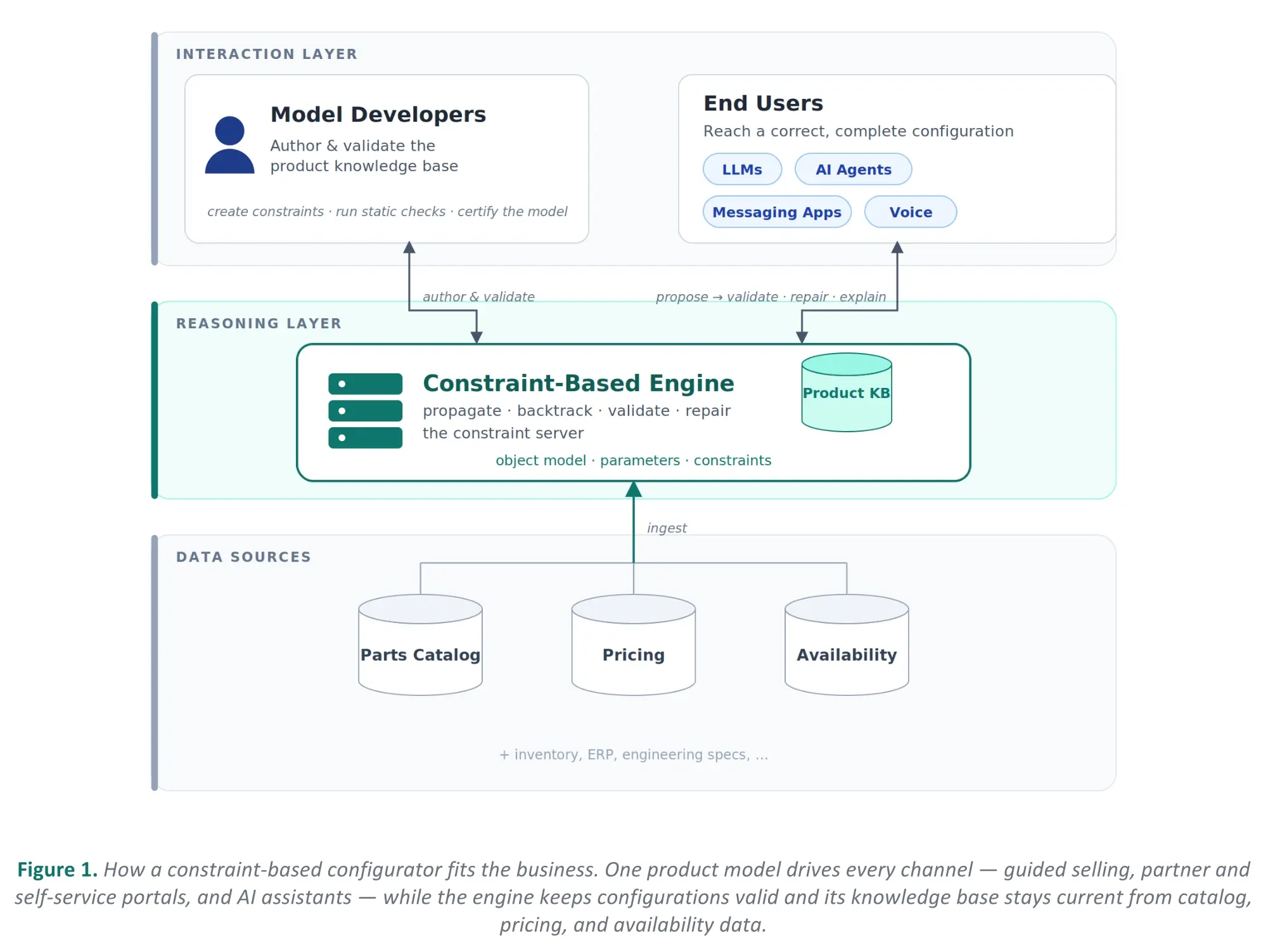
One model can then be operated in two modes. The engine can drive the conversation itself — asking the next relevant question and offering only the choices that remain valid — or it can sit silently behind another interface, including an AI assistant, and validate or repair whatever that interface proposes. Constraints can also guide rather than enforce: some surface advice that explains what is wrong and why without blocking the user, while others are hard requirements the engine will not violate. The same model can therefore be both a forgiving advisor and a strict guarantor — a choice the business makes rule by rule.
What the business gets
Accuracy and lower risk
Because configurations are valid by construction, invalid quotes stop reaching customers. That means fewer change orders, less rework, fewer delivery surprises, and lower warranty, safety, and compliance exposure. On products where an error is measured in stranded capacity or an unbuildable order, this is the difference between a quote that closes cleanly and one that becomes a costly problem after the signature.
Agility and lower total cost of ownership
This is the payoff executives feel most over time. Because a constraint model grows with distinct relationships rather than with the exponential space of their combinations, it stays maintainable as the product line expands. Changes are localized and low-risk, new products and options ship faster, and the organization depends far less on a handful of irreplaceable experts. The maintenance curve flattens instead of compounding.
Speed, revenue, and reach
Accurate, goal-first, any-order interaction shortens complex deal cycles: a buyer can lead with an outcome and let the engine work out a valid, priced configuration, rather than being marched through a script. The same flexibility makes it practical to open guided self-service and partner channels that were previously too error-prone to trust, expanding reach without expanding risk. Faster, more accurate quotes mean fewer stalled deals and less quote leakage.
A better experience for everyone
Experts get a tool that keeps up with how they actually think; non-experts get a guided experience that explains why a choice is or isn't available; and every channel draws on the same guaranteed-correct model, so the answer a customer gets is consistent no matter how they engage.
AI-readiness: the strategic dimension
The most consequential reason to get this foundation right is what comes next. Large language models bring something genuinely new to selling, i.e., fluency. They can hold a natural conversation, interpret a customer's intent, and translate it into product terms. What they cannot do on their own is guarantee correctness — they will confidently propose configurations that cannot be built.
This is not a hypothetical risk. We have measured it directly. Across 242 test runs against a dense body of real-world eligibility rules — EU flight-delay compensation law, chosen because it has the same shape as a hard business rule set — a leading language model's raw accuracy was 51.65%, improving to roughly 70% with a newer model, and even then only 14 of 22 test cases produced the same answer every time they were asked. A separate study against a live provider's actual buy-now-pay-later policies found accuracy ranging from 20% to 77% depending on how the rules were delivered to the model — meaning even the best setup got roughly one in four answers wrong. In both studies, routing the model's proposed answer through a deterministic check before it reached the user brought accuracy to 100%. Configuration is a more structured, more tractable problem than either of these — but the underlying failure mode is the same one: fluent, confident, and wrong, at a rate no business can absorb at scale.
A constraint engine supplies exactly what an AI assistant lacks: deterministic, guaranteed-correct validation. Pair the two and the AI carries the conversation while the engine ensures every proposal is buildable and repairs the ones that aren't. You get the fluency of AI and the correctness of a deterministic solver. Critically, an AI assistant produces input the way real buyers do — as goals, out of order, a bit at a time — which is precisely what a constraint engine handles and a decision tree cannot. The same architecture that makes the model maintainable is what makes it AI-ready.
The strategic implication is straightforward: constraint-based configuration is the deterministic backbone for trustworthy AI-driven selling and self-service. Adopting AI in the quoting process without a sound validation layer beneath it is a risk multiplier, not a shortcut.
Governance, trust, and control
A deterministic engine is also an auditable one. Every constraint can explain what is wrong and why, so guidance to buyers and reviewers is transparent rather than a black box. No invalid configuration reaches a customer, authors control precisely which rules advise and which enforce, and the model provides a single, inspectable record of the rules the business runs on. For CIOs and risk owners, that combination — correctness, explainability, and control — is what makes it safe to put configuration in front of customers and, increasingly, in the hands of AI.
Why this matters now
Three forces make the foundation decision urgent. Products are getting more complex — more software-defined, more interconnected, more configurable as services — pushing more companies past the point where rules-based CPQ holds up. AI is reshaping how customers expect to buy and how vendors sell, and conversational, self-service interaction only works over a correctness layer. And many organizations are re-evaluating aging CPQ platforms as the market goes through a generational transition. That re-evaluation is a rare window: a chance to adopt the right foundation deliberately, rather than re-entrench a rules-based approach for another decade.
Proven foundations, low-risk adoption
Constraint-based configuration is neither new nor unproven. It is a mature discipline with a lineage running from foundational AI research at Xerox PARC through the enterprise CPQ category itself. Predictika's team defined that category at Selectica, building it from inception to a $5 billion IPO and delivering configuration for major global enterprises including IBM, Cisco, Dell, and GE. Predictika extends that lineage with patented technology (U.S. Patents 11,544,475 and 11,914,970) for deterministic validation, now positioned as the backbone beneath AI-driven configuration.
Adoption need not be a rip-and-replace. Because the engine can sit behind existing interfaces and validate or repair what they propose, it can be introduced first as a deterministic validation layer over the highest-complexity product line — proving value on the deals where errors cost the most, without disrupting the rest of the stack.
Conclusion
For complex products, the configurator is strategic infrastructure, and the way it represents the product is a decision with a decade of consequences. Rules and decision trees impose a rising tax — in errors that reach customers, in maintenance that compounds, in rigidity that frustrates buyers, and in an architecture that AI cannot safely build on. A constraint-based foundation turns that liability into an advantage: configurations that are correct by construction, a model that stays affordable to change, an experience flexible enough for experts and self-service alike, and a deterministic backbone ready for AI-driven selling.
The practical next step is modest: identify where configuration complexity is costing the business the most today — in errors, in quote cycle time, or in maintenance drag — and evaluate a constraint-based approach there first. That is where the case proves itself.
Suggested Further reading
Complex Product Configuration Requires a Constraint-Based Approach — the deeper technical case for the approach this paper summarizes https://predictika.ai/assets/doc/Complex_Product_Configuration_Requires_a_Constraint_Based_Approach.html
Requirements for a Constraint Server Behind an LLM Front End — what the engine itself needs to do, for technical evaluators https://predictika.ai/assets/doc/Requirements_for_a_Constraint_Server.html
You May Not Realize It, But Your Business Has a Configuration Problem — a shorter, self-diagnostic companion for readers who want to
confirm they have this problem before reading further
Accuracy Is Not Consistency — the EU261 study behind the AI-readiness evidence in Section AI-readiness: the strategic dimension
https://predictika.ai/assets/doc/Accuracy_is_not_consistency.html
Logic Engines to Guide LLMs for Accurate and Reliable Reasoning — the BNPL study behind the same evidence, and the general architecture https://predictika.ai/assets/doc/Guiding_AI_agents_to_reason_correctly.html
About Predictika
Predictika builds a patented constraint-based configuration engine for complex products, pairing a declarative modeling language with a logic core whose lineage runs from foundational AI research at Xerox PARC to proven, large-scale enterprise configuration at Selectica. The company applies that engine both as a configuration core for complex products and as a deterministic validation layer beneath LLM driven assistants, giving natural language systems the soundness that high-cost-of-error domains require.
About the author
Dr. Sanjay Mittal is the founder and CEO of Predictika and the architect of its constraint-based reasoning engine. He began his career as a research scientist at Xerox PARC (1982–1990), with pioneering work in artificial intelligence and constraint reasoning. He went on to found Selectica, which defined enterprise sales configuration (CPQ) for large organizations, building it from inception to a $5 billion IPO and serving customers such as IBM, Cisco, Dell, GE, Hitachi, Disney, AT&T, and Reliance. Dr. Mittal was the inventor of Selectica’s industry-leading configuration engine and holds six patents from that work. At Predictika he has carried the constraint-based approach into the era of large language models, with further patents — including U.S. Patents 11,544,475 and 11,914,970 — covering the deterministic validation of LLM driven systems. He holds a B.Tech. from IIT Kanpur and a Ph.D. from Ohio State University.
Copyright © Predictika Inc. 2026